
Conceptual Framework
Understanding the concepts of sustainability, environmental sustainability, and environmental conservation is essential for understanding the interconnectedness of human activity, natural resources, and ecosystem health.
▪ Sustainability
Sustainability is often defined as a development model that meets present needs without compromising the ability of future generations to meet their own.
Sustainability addresses critical environmental issues, ranging from pollution and climate change to resource depletion and biodiversity loss, all of which threaten ecological balance and life on Earth (Enel, 2024). This concept was popularised in the 1987 Brundtland Report, which emphasised a balance between social, economic, and environmental demands. In other words, sustainability involves using resources wisely to preserve them for future generations.
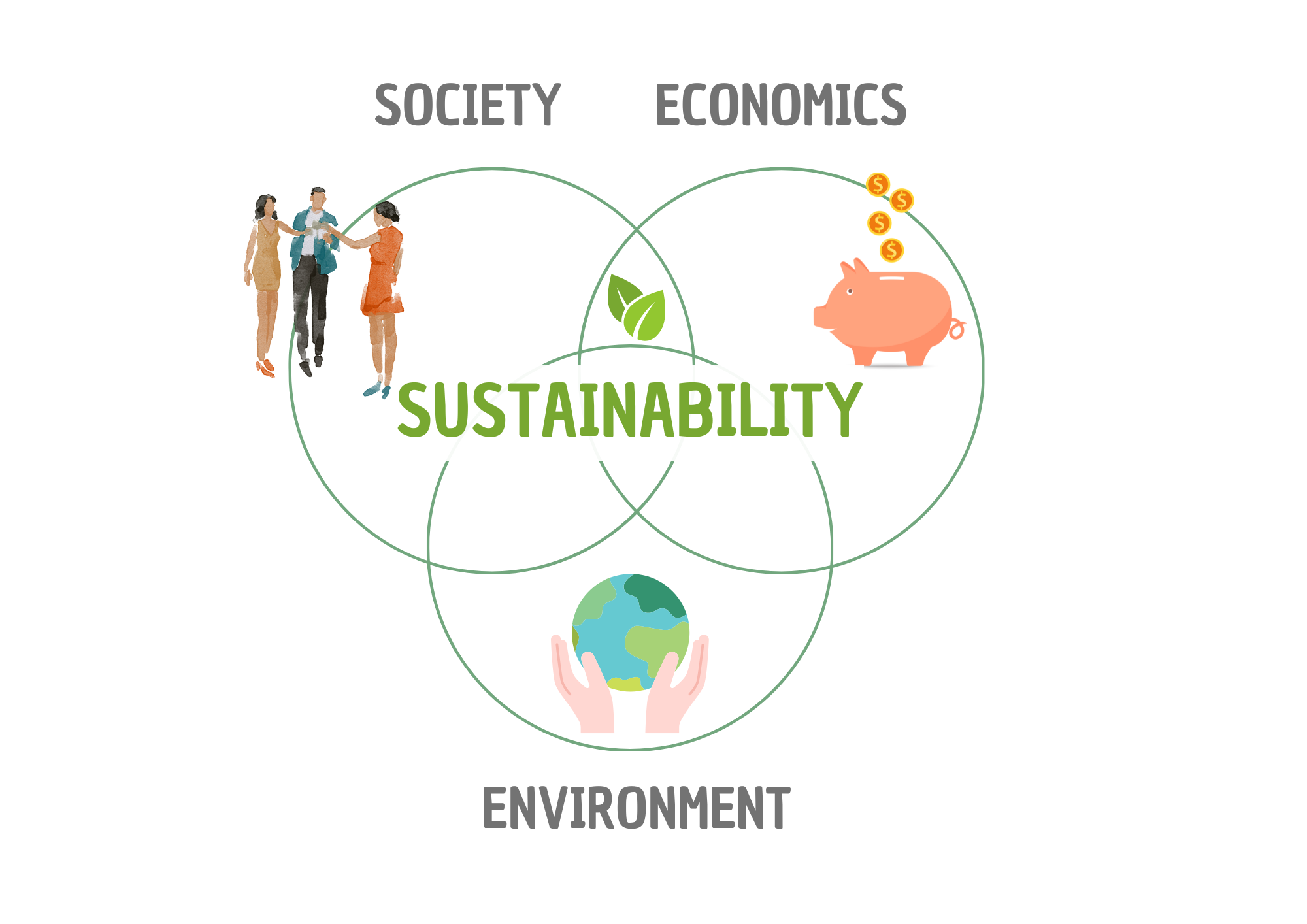
THE THREE PILLARS OF SUSTAINABILITY
Essentially, the three pillars underline the fact that purely environmental sustainability is not enough on its own, as economic, social and environmental processes are always interconnected.
The climate crisis illustrates this clearly. It has an obvious environmental component: temperatures are soaring, glaciers are melting, and sea levels are rising. At the same time, this has serious consequences for the economy and society. For instance, extreme weather events lead to crop failures and droughts, causing famine in developing countries (myclimate, 2024).
▪Environmental sustainability and conservation
Among the three pillars we see in the figure, there’s one which will help us understand this module better: The environmental pillar. It refers to the “ability of an ecosystem to sustain and grow its inhabitants, remaining healthy and balanced. It is a crucial aspect of contemporary existence, as human civilisation increasingly relies on ecosystems and natural resources for survival” (DEISO, 2023).
This concept relies on the idea that the environment is the foundation of all life, including human society and economies. Without clean air, fresh water, fertile soil, and healthy ecosystems, human civilisation cannot flourish. More accurately, it defends environmental quality and resource conservation, encouraging practices such as reducing consumption and waste, promoting recycling, developing alternative technologies and accelerating the use of renewable energy sources.
Some of the factors influencing environmental sustainability are:
– Air, water and soil pollution
– Climate change, caused by the excessive amount of greenhouse gases released into the atmosphere due to human activities
– The loss of biodiversity
– The overexploitation of natural resources
– Economic models that involve unsustainable consumption.
Environmental sustainability is the key to human well-being in the present and future.
(Howell, 2024)
Nowadays, both environmental degradation and unsustainable human activities (e.g. deforestation) are slowing down the ecological balance in our planet’s natural environment. That’s the reason why it is one of the biggest hopes we have in fighting environmental challenges:
-It considers future generations
-It protects wildlife
-Improves human health
-Economically beneficial
Among the various concepts that exist in the field, we can also find environmental conservation, which includes maintaining and repairing the environment using renewable resources, reducing pollution, and protecting biodiversity. It is the area in which the phrase “environmental sustainability” is most frequently used. Environmental sustainability includes environmental conservation as a fundamental component (DEISO, 2023).
Major environmental challenges are placing immense strain on human life. Problems like overpopulation, water shortages, ozone layer damage, climate change, deforestation, desertification, and pollution pose serious risks to human survival. To make real progress in addressing these issues, environmental conservation needs to become a widespread movement, especially as digital media offers powerful tools to inspire a global effort to protect the planet from ongoing damage.
“Some of the most known methods that promote environmental conservation are forest conservation, soil conservation, waste management, public awareness and pollution control” (Leverage Edu, 2022).
Unlike environmental sustainability, which encompasses all practices aimed at reducing overall environmental impact, conservation specifically emphasises protective measures for ecosystems and species at risk. Conservation actions include preserving habitats, regulating resource use, restoring degraded areas, and establishing protected areas.
To better understand and reflect on the concept of Sustainability, we recommend watching the insightful TED Talk by Environmental data scientist Hannah Ritchie, “Are We the Last Generation – or the First Sustainable One?” available on YouTube:
https://youtu.be/Kl3VVrggKz4?si=5Pq7XCItd2vgrGRP
Sustainable Tourism and Green Entrepreneurship
▪ Sustainable Tourism
Sustainable tourism has gained significant importance over the past decade, not only for its positive impact on local economies but also for its role in preserving environmental and cultural resources.
Sustainable Tourism is a responsible approach to travel that aims to protect the environment, preserve local cultures and support communities.
The origins of the phenomenon date back to the 1980s, and its evolution closely follows that of “sustainable development” (Enel Green Power, 2024).

Image 18 Freepik.es
In the 2030 Agenda for Sustainable Development, SDG target 8.9 aims to “by 2030, devise and implement policies to promote sustainable tourism that creates jobs and promotes local culture and products”. The importance of sustainable tourism is also highlighted in SDG target 12.b., which aims to “develop and implement tools to monitor sustainable development impacts for sustainable tourism that creates jobs and promotes local culture and products” (UN, 2024).
▪ Green entrepreneurship and tourism
Green entrepreneurship in tourism refers to creating and managing businesses that prioritize sustainable practices. These businesses implement initiatives such as renewable energy use, waste reduction, and a preference for locally sourced materials, appealing to an increasing number of environmentally conscious travellers (Leverage Edu, 2022). This approach aligns with the “Triple Bottom Line” framework—balancing people, planet, and profit—not only boosting green tourism but also enhancing the long-term profitability of sustainable businesses.
The adoption of these practices is driven by both environmental benefits and a growing demand from tourists seeking eco-friendly accommodations and experiences. In 2023, 78% of travellers planned to stay in eco-friendly accommodations, demonstrating a preference that helps mitigate the environmental impact of tourism (Avantio, 2023).
Innovations in sustainable tourism address the challenges of traditional tourism models. By adopting sustainable practices, tourism destinations can protect natural and cultural resources and ensure their long-term viability. These innovations, often driven by green entrepreneurship, also promote positive social and environmental change within the industry (Al-Romeedy, 2024).
The Global Sustainable Tourism Council (GSTC) provides a policy framework that helps destinations manage tourism sustainably, including regulations in areas such as urban development, environmental protection, safety, accessibility, and property rights (Day, 2024). These policies are essential to prevent issues like over-tourism and to ensure harmonious and respectful development in local communities.
▪ Destination Life Cycle
Sustainability in tourism has become a top priority for travellers. As of 2024, 83% of travellers view sustainable travel as essential, reflecting growing environmental awareness amid climate change concerns (Statista, 2024). Additionally, a recent study found that 40% of travellers are willing to travel off-peak and avoid popular destinations to lessen their environmental impact, seeking more authentic and responsible experiences (Avantio, 2023).
The Butler Destination Life Cycle Model offers a useful framework for understanding the evolution of tourism destinations (from exploration to consolidation) and how sustainable practices can be integrated at each stage. In the early stages, investing in sustainable tourism helps avoid future issues like congestion and environmental degradation, maximizing long-term benefits. Although the model has been criticized for its simplicity, it remains a valuable reference for tourism development (Tamanine & Houssas, 2023).
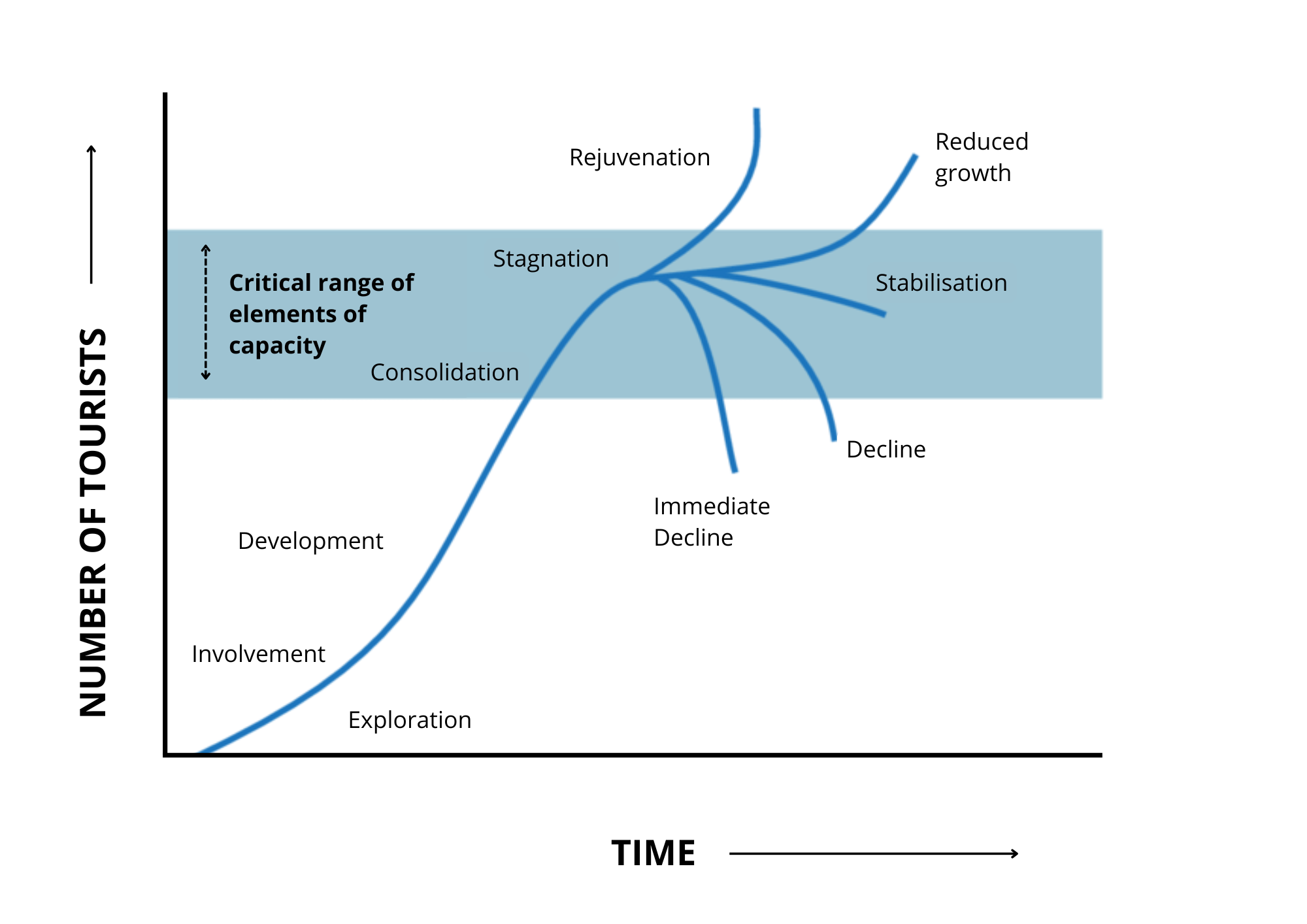
Figure 8
https://www.researchgate.net/
For a comprehensive understanding of how tourism can actively contribute to the Sustainable Development Goals (SDGs), we highly recommend exploring the report Tourism and the Sustainable Development Goals – A Journey to 2030, published by the United Nations Development Programme (UNDP). This resource offers insights into aligning tourism practices with global sustainability goals, highlighting practical examples and strategies that support social, economic, and environmental well-being. It’s an essential read for those working to make tourism a driving force in sustainable development, providing actionable guidance and inspiring case studies that can inform sustainable tourism initiatives worldwide.
Indeed, travellers’ expectations for sustainable practices are also on the rise. Booking.com data reveals that travellers expect accommodations to implement sustainable practices, such as energy-saving sensors and alternatives to single-use products. Furthermore, 42% of tourists prefer to support local businesses, encouraging destinations to promote collaboration with local suppliers and service providers.